
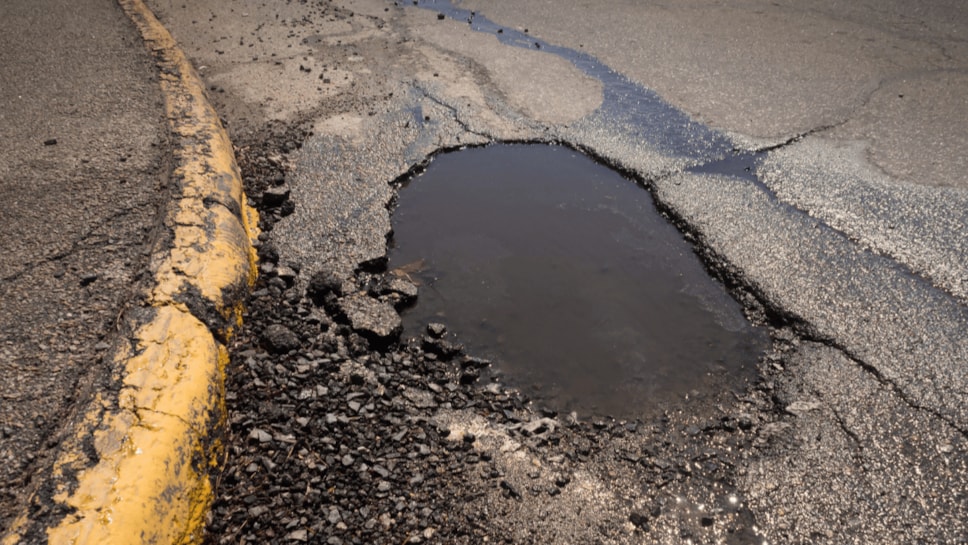
‘Crater’ pothole takes Transport Secretary off the road: insurance experts reveal how to claim
Go.Compare reveals £10.2 million was paid out in pothole claims between 2022 and 2024
With news just in that Transport Secretary Heidi Alexander has been taken off the road after a ‘crater’ of a pothole took her Mini Cooper off the road,* the car insurance experts at Go.Compare are urging motorists to claim back their pothole damage – and revealing how to do so.
Research from the comparison site has revealed that between 2022 and 2024, councils across England and Wales paid out £10.2 million in pothole claims** – and Oxfordshire, where the Transport Secretary’s pothole encounter took place, is one of the top ten councils with the highest claims payouts.
Councils paying the most in pothole compensation claims to drivers (2022-2024):
|
|
Councils |
£ spent on claims to drivers (2022-2024) |
|
1 |
Staffordshire CC |
£1,039,522.93 |
|
2 |
East Sussex CC |
£598,112.00 |
|
3 |
Derbyshire CC |
£526,089.62 |
|
4 |
Havering |
£450,000.00 |
|
5 |
Wiltshire Council |
£448,950.99 |
|
6 |
Barnet |
£424,370.00 |
|
7 |
Warwickshire CC |
£414,495.00 |
|
8 |
Shropshire Council |
£385,342.00 |
|
9 |
Oxfordshire CC |
£321,975.00 |
|
10 |
Surrey CC |
£316,331.38 |
Additionally, not all councils appear to be tackling the pothole problem in a timely manner. Go.Compare submitted a freedom of information request to 171 councils about their pothole repair times and found that Staffordshire was the slowest in 2024, taking an agonising 210 days on average to repair a pothole. Meanwhile, Oxfordshire, where Heidi Alexander fell foul of a pothole, took just 9 days on average.***
Tom Banks, motoring expert at Go.Compare Car insurance explains how you can give your pothole claim the best chance of success: “Potholes are a sadly familiar sight on our roads, so if you’ve hit one, you’re not alone. In fact, there were a reported 1 million cases across the country in 2024 alone.**
“If your car suffers any damage due to a pothole, we recommend making a claim as soon as you can. However, there are a few things to consider. Here’s our advice when it comes to claiming:
- Check it’s really a pothole: to be technically classed as a pothole, the hole needs to be at least 40mm deep, which is about the height of two 20p coins
- Gather evidence: You’ll need to show evidence to back up your claim. If it’s safe to do so, get a photo of the pothole and make a note of exactly where it is. You can use What3words to communicate its exact location, and remember the date and time you hit it. If anyone saw the incident it could be helpful to get a statement from them.
- Talk to your mechanic: Any damage you claim for must be due to impact with the pothole, so if your car has to go to the garage and requires work, make sure you keep a record of everything and ask your mechanic to confirm this in writing.
- Contact the right authority: Depending on the type of road, a different authority will be responsible. For example, red routes in London are run by Transport for London rather than National Highways. You can find out who to contact here.
- Insurance claims: A claim on your insurance policy shouldn't be your first port of call, but if you do decide to make a claim it’s worth noting that your insurance premiums could rise in the future as a result.”
For more information on how to make a pothole claim, visit here.
Contact Information
Alex McCormick
Notes to editors
* https://www.telegraph.co.uk/news/2026/04/16/transport-secretary-heidi-alexander-car-towed-pothole/
** Pothole data obtained through FOI or readily available on council websites, from date ranges varying 1 January 2022 to 31 December 2024.
***Pothole data obtained through FOI or readily available on council websites, from date ranges varying 1 January 2022 to 31 December 2024. Of the 171 councils asked about repair times, 69 provided data.
Contact us:
For further information please contact: Go.Compare@fdcomms.co.uk
About Go.Compare
Go.Compare is a comparison website that enables people to compare the costs and features of a wide variety of insurance policies, financial products and energy tariffs.
It does not charge people to use its services and does not accept advertising or sponsored listings, so all product comparisons are unbiased. Go.Compare makes its money through fees paid by the providers of products that appear on its various comparison services when a customer buys through the site.
When it launched in 2006, it was the first comparison site to focus on displaying policy details rather than just listing prices, with the aim of helping people to make better-informed decisions when buying their insurance. It is this approach to comparing products that secured the company an invitation to join the British Insurance Brokers’ Association (BIBA) in 2008, and it is still the only comparison site to be a member of this organisation.
Go.Compare has remained dedicated to helping people choose the most appropriate products rather than just the cheapest and works with Defaqto, the independent financial researcher, to integrate additional policy information into a number of its insurance comparison services. This allows people to compare up to an extra 30 features of cover.
Go.Compare is part of Future Plc and is authorised and regulated by the Financial Conduct Authority (FCA).
More information can be found here www.gocompare.com or here https://www.futureplc.com/brands/.